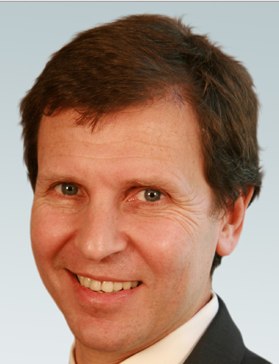



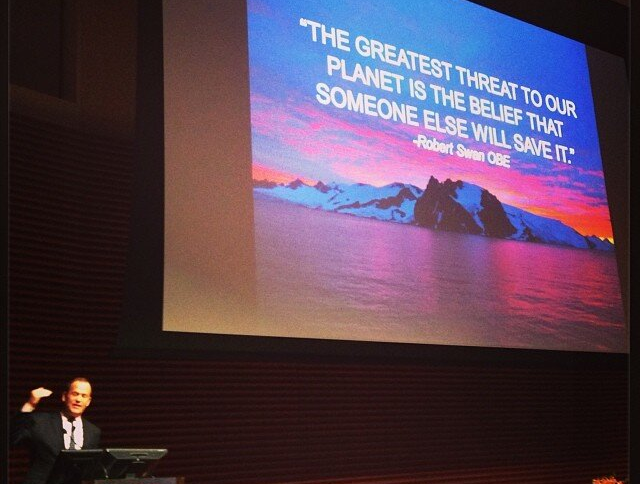
Will Sarni firmly believes that if your company is not engaging in viable sustainable initiatives, it’s positioning itself as a dinosaur. I asked Will how he advises companies–like Coca-Cola and Wrigley–on sustainability, whether sustainability has finally shed its skin as a moral initiative and when things ‘tipped.’

Will is the Founder and CEO of DOMANI Sustainability Consulting based in Denver. DOMANI is an environmental consulting firm that helps the private sector and large multinationals develop or expand their sustainability strategies.

Why do companies come to you for help? Is it to increase profits or gain better brand recognition or public image?

Typically, our clients have at least one of three objectives: Increasing revenue, either through developing new products or services or by increasing brand value; managing risk by understanding their risk exposure through their supply chain; or reducing operating costs.  The last one has been a major issue for most of our clients this year. They’re looking for ways to reduce their energy spend and carbon footprint.
[click to continue…]

{ 2 comments }

Picture 4Working with the concept of large-scale applicability, here are the top 10 things I learned at the Sustainable Brands conference earlier this month in Monterey:

1. Consumers trust brands more than they trust the government.

(Annie Longsworth, Managing Director, Cohn & Wolfe)
Republicans and Democrats meet at the checkout. Brands have a colossal toolkit to affect positive change. They’re working from a current level of high consumer trust.
[click to continue…]

{ 4 comments }

GoodGuide Screen ShotLead, carcinogens, partially hydrogenated soybean oil, diglycerides, formaldehyde, imidazolidinyl and a slew of other largely unpronounceable ingredients are mainstays in our food and beauty products and assailants on our health. A new iPhone app and its web version are helping consumers make informed purchases at the point of sale.

GoodGuide gives consumers access to product ingredients (the good and bad ones) and their side effects, while also providing information on how socially and environmentally active the manufacturer is.  Shoppers enter a product’s name in GoodGuide and receive a combined score that reflects that product’s harmful ingredients and severity of related side effects (think rash vs. cancer). [click to continue…]

{ 4 comments }

Give Something Back, an office supply company with an unusual business model, won two accolades from Inc. Magazine in the same year; it was billed as one of the country’s fastest growing companies and lampooned as the worst corporate name in America. I spoke with Give Something Back’s Mike Hannigan about a new set of stakeholders, marketplace competition and spaghetti sauce.

Founded in 1991 by Mike Hannigan and Sean Marx, Give Something Back has grown into the West Coast’s largest independent office supplier with corporate offices in three cities and 12,000 clients and 40 distribution centers nationwide. You’re reading about Give Something Back now, not because of the company’s overnight delivery or tremendous selection of recycled products, but because it donates all after-tax profits to nonprofits through a balloting system that involves GSB’s customers and employees. Based on Newman’s Own business model, Give Something Back has donated more than $4 million (80% of its accumulated profits) to nonprofit organizations in the last 17 years.

Why do this?

Both Sean [Marx] and I had a significant amount of experience in the competitive area of office products.  The company we were running was bought by a big multi-national and we had a choice to make. We both felt we could use [the model of Newman's Own] in a competitive, hard-nosed industry to make a profit, but do it on behalf of a different set of stakeholders. We are essentially a giant bake sale serving the nonprofit community. [click to continue…]

{ 2 comments }

Jay Coen Gilbert of B Lab, the non-profit that certifies and supports B Corporations, distinguishes between good companies versus good marketing, and how B Lab is supporting the broader social shift from green businesses to good businesses.

What are B Corporations?

B Corporations are a new kind of company that use the power of business to solve social and environmental problems. Currently, there are more than 200 certified B Corporations, which collectively represent more than a billion dollars in revenue and come from 30 industries throughout 30 U.S. sates. [click to continue…]

{ 2 comments }

I spoke with Ron Gonen, co-founder and CEO of RecycleBank, to learn how he built one of the largest public-private partnerships that creates incentives for social good.

RecycleBank is a reward program that motivates people to recycle by measuring the amount of material each home recycles and then converting that activity into RecycleBank points that can be used at more than 1,500 local and national reward partners like Target, Kraft foods, Coca-Cola and Starbucks. Households can earn up to $400 annually in RecycleBank points. The program piloted in Philadelphia in 2004. It’s expanded to 20 states and is days away from its UK launch.

Why recycling?

I’ve always had an interest in social policy and the environment, and I wanted to make sure that what I did could have an impact today.  There’s a lot of great discussion around global warming and climate change and things like the electric car. Those are all very important initiatives, but they don’t relate to the average person’s life today; the average person can’t get involved and I think it’s incredibly important for the environmental community to remain sustainable and you do that by getting people active at a large scale right now.  So I took it as my goal and my interest to find something that would activate people’s interest in the environment today.  Recycling is something that touches everybody: you could be rich, poor, black, white, Hispanic, urban, suburban. If you bought something during the week, you should be recycling it.  I felt like [recycling] would give me maximum penetration to touch the most amount of people. [click to continue…]

{ 2 comments }

Lightning strikes miss LibertyRecently, I had the opportunity to proselytize socially beneficial business models to a crowd of upstart entrepreneurs with varying levels of interest in social responsibility.

I spoke with upstart entrepreneurs about five ways they can incorporate cause into their business, regardless of its size. Although the methods range in their levels of commitment and implementation time, they all display action on the behalf of a cause.

  1. BOGO: Buy-One-Give-One

    With a BOGO business (a company that donates an exact item match for every item sold) cause is at the core of the business model. BOGO businesses have dual objectives, to support and enhance their causes and to turn a profit (the latter, the distinguishing factor from a nonprofit).  Exemplary BOGO businesses are Nicholas Negroponte’s One Laptop Per Child, The BoGo Light by Sunnight Solar and TOMS Shoes.

    WHAT TOMS GIVES:
    Millions of pairs of shoes to children in need in South America and Africa.
    WHAT TOMS GETS: Recognition for pioneering the BOGO business model and a vocal following of die-hard fans. [click to continue…]

{ 4 comments }


Right click to download.

Picture 2Andrew Meredith and Daniel Ebner were frustrated by the global shortage of clean water and by the lack of transparency in their cause-related purchases–t-shirts or bottled water that advertised a charitable contribution without disclosing what that cut translates to in dollars and cents. From these two pain points, Meredith and Ebner launched WeDrink, a for-profit company that sells sustainable aluminum and steel water bottles and donates precisely 50% of the purchase price to non-profits working to alleviate the world’s water crisis. WeDrink sells a 25-oz. aluminum water bottle for $18. Half of this ($9) goes directly to WeDrink’s nonprofit partner PlayPumps International to fund 10 years worth of clean drinking water for one individual. [click to continue…]

{ 3 comments }

CauseCapitalism.com David Hessekiel, Cause Marketing ForumDoes it seem counter-intuitive that cause marketing programs are continuing to prosper in a pinched  economy? I talked with David Hessekiel, president and founder of Cause Marketing Forum, about why  cause-related marketing campaigns have a current advantage, best practices for starting a cause marketing program and how to protect your company from accusations of ’cause-washing.’ 

About Cause Marketing Forum
Cause Marketing Forum, Inc. was founded in 2002 to help companies and nonprofits do well by doing  good. The company helps businesses and non-profit executives succeed together through online resources such as case studies, statistics and interviews, a teleconference series and an annual conference.

Why, despite belt-tightening by companies and consumers, is cause marketing is holding up better than some other forms of marketing?

  1. There’s increasing evidence that cause marketing, in all its many forms, is an effective marketing strategy. Its efficacy has been proven time and again. Particularly now, there’s an strong desire among many people to do something to help their fellow man or the planet.
  2. There’s a danger with other forms of marketing and communications, like sports and entertainment marketing, that they will be perceived as frivolous.
  3. The shift in cause marketing reflects a shift in society’s concern for basic needs like housing and food. More companies are partnering with basic-need charities, which focus on hunger and shelter.

What are some best practices for launching a cause marketing program?

  1. Doing good doesn’t assuage you from being smart. Don’t expect a leg up, just because your company is doing something worthy. A successful cause marketing campaign requires all of the other rigorous effort that you would put into creating any other marketing program. You need to be smart, dedicated entrepreneur to make these programs work.
  2. Know your goal. Determine exactly what you want to achieve (employee attraction and retention, customer acquisition, business to business relationships) and then see if there’s cause related strategy that you can use to effectively achieve your objective. Lastly, measure how successful the program was so that you can course-correct and improve future results.
  3. Clear communication. Your target audience has a very limited amount of attention give to anything. If the link between your product, cause and action is complex, you will loose your customer–just as you would with any other blurred marketing message.
  4. Pick your partner well. Find a partner with complementary assets, be they events, communication vehicles or intellectual property. Collaborating with a harmonizing
    company or non-profit enables you to better leverage your combined resources to create the program.
  5. BONUS: Iconography. Think Pink Ribbon, Red Dress, Yellow Wristband.

How can companies avoid accusation of cause-washing?

  1. Be clear in explaining what it is your company is doing. If you are making contributions, make it very clear what is triggering those contributions and what, if any, are the limits on those contributions.
  2. Have a clear understanding of who your partners are (both corporate and nonprofit). Be comfortable with the history and practices of the company or charity you’re working with; if your program is scrutinized, as such programs usually are, you can clearly explain why you elected to work with your partner within the context of the marketing program.

If you’re looking for more best practices, case studies or contacts in the sector, check out www.causemarketingforum.com.  Executives from Burt’s Bees and Timberland, among others, will talk about how they built their world-class programs at CMF’s next conference, May 27-29 in Chicago.

{ 0 comments }

CauseCapitalism.com BOGO SunNight SolarGo Green Solar founder Deep Patel is a solar energy aficionado, social-good actor and reader of this blog.

Patel recently spoke about a plan he’s developing, which would bedeck the Hollywood sign with solar panels to capitalize on the sign’s solar energy real estate and drive energy back into Los Angeles’ grid-tie system. As I was talking with Patel afterward and learning just what a grid-tie is, he brandished an orange flashlight with a proud grin and announced his company as the lamp’s latest distributor. It was a BOGO Light from SunNight Solar. Patel had read my post on SunNight Solar’s Buy-One-Give-One (BOGO) business model, contacted its founder Mark Bent, and brokered a partnership to sell the solar-powered flashlights and under the Buy-One-Give-One sales model.

Here’s the shakeout: an active distribution channel for SunNight Solar, a dynamite product in Go Green Solar’s inventory, another individual with nighttime access to light, and a marvelous anecdote about the power of mission–and of blogging, for me.

{ 0 comments }